Listing Presentation Guide
Listing Presentation Guide: Win More Listings in 5 Steps
How to win listing appointments: what to do before you knock, in the first 15 minutes, on price, and when sellers push back. From Beacon's launch webinar.
Short answer: A listing presentation is the pitch you give a home seller to win the listing. The agents who win competitive appointments do five things: they prepare before they knock, make the first 15 minutes about the seller, sell their process instead of the outcome, handle price early, and answer objections with questions instead of defense. This guide covers each step, using the playbook Chris Smith and Jimmy Mackin taught live to roughly a thousand Realtors at the Beacon launch webinar.
Key takeaways
- Do not wing it. The presentation is not for you. Sellers do this once or twice in their lives, so they need to see and understand your plan.
- Send a micro-presentation 24 hours before. Your bio, a market snapshot, and reviews relevant to their home, so you never spend the appointment on "who we are."
- Sell the process, not the outcome. You do not control the sale price. You control the marketing, negotiation, and problem solving that drive it.
- You have six weeks, not six months. Jimmy Mackin's analysis of 9,500 expired listings found the average agent signed a 6-month agreement and the listing expired with 132 days left.
- Answer objections with questions. "What makes you say that?" beats a defensive pitch every time.
- Personalize it. Show their home, their goals, and their marketing plan, not a recycled deck that might as well say "prepared for 123 Generic Street."
What is a listing presentation?
A listing presentation is the meeting, and the materials you bring to it, where a Realtor explains to a prospective seller how they will market and sell the home, what price they recommend and why, and what it will be like to work together. It is where the listing is won or lost, which is why Chris Smith calls it one of the very few things in real estate that directly makes you money or not.
It usually combines your story and track record, a market and pricing analysis (comps and active competition), a marketing plan, a timeline, your fee and terms, and a clear next step. Many top agents also send a shorter pre-listing presentation before the appointment.
The 5-step listing presentation process
The webinar broke the appointment into five parts. Here is the framework with the specific tactics from each.
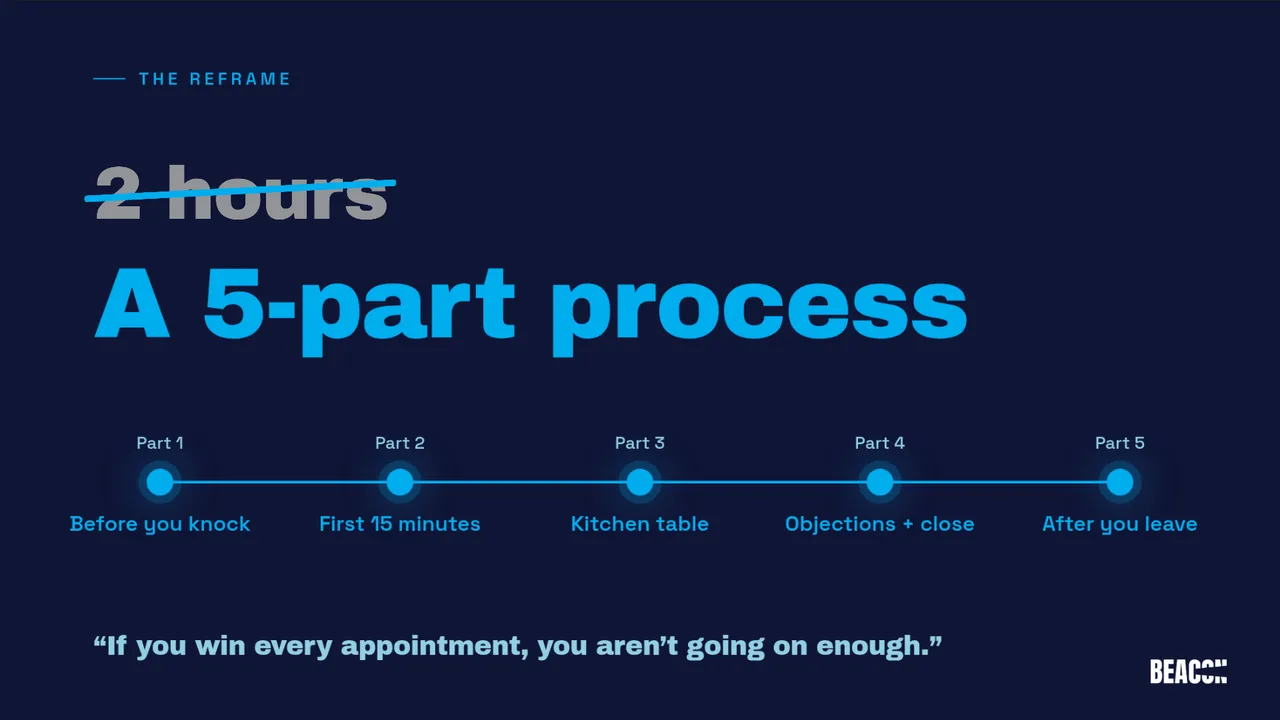
Step 1: What to do before you knock on the door
Run a real intake call. Jimmy Mackin's guidance: understand where the seller is going next, because that reveals their true motivation. Timeline is mission critical, along with the X factors behind it, such as a job change, a divorce, or an inherited home. The goal is insight you can use in the presentation, so the seller feels heard and never has to start over. Chris adds that people often tell you more over the phone than they will in person.
The six minimum intake questions from the webinar:
- Where are you going?
- When do you need to be there?
- What is the best case scenario at the end of this process?
- What have you done to the house?
- What will you miss about the house?
- What is important to you about the sale?
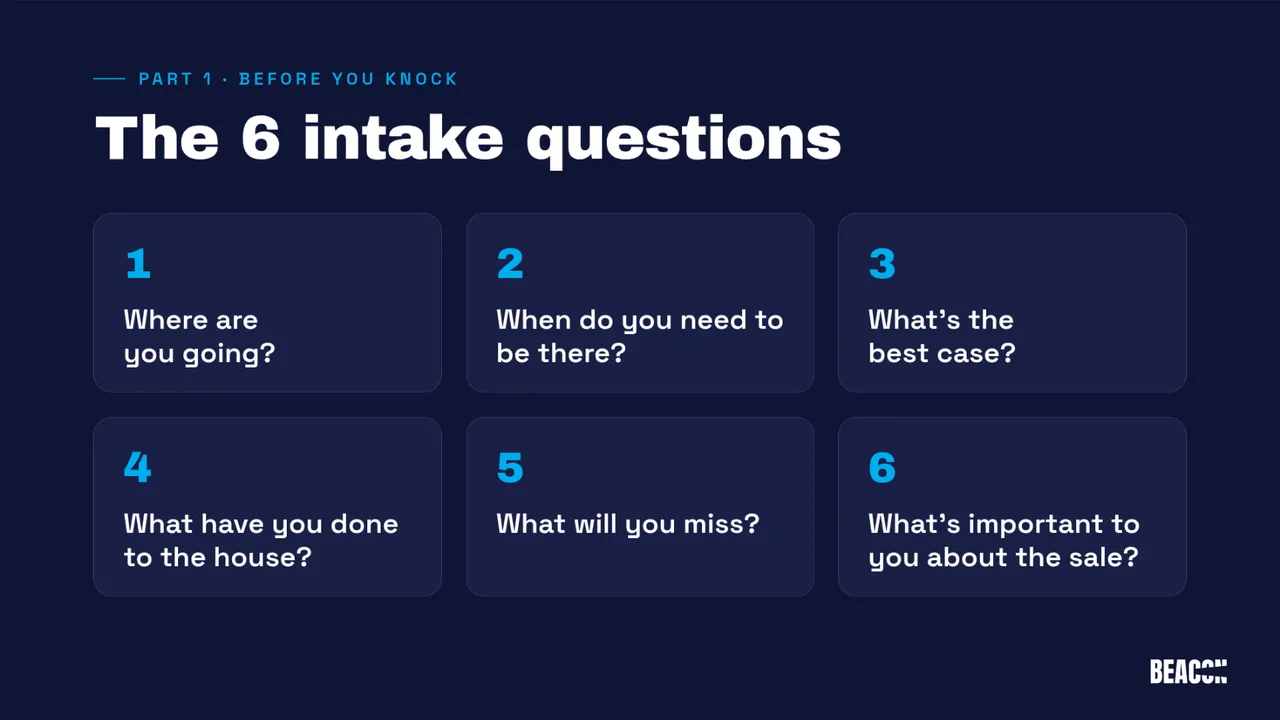
Then dig deep: as they answer each question, ask the follow-ups you did not know you needed. If they say they are moving to a certain neighborhood, ask why that one and not the one next to it.
Know what sellers will ask. Sellers now use AI before they interview you. Chris asked ChatGPT how to interview listing agents, and the top questions were: can you show me the marketing you created for your last three listings, what price do you recommend and which comparables support it, what homes would we compete with if we listed today, and what homes have you sold recently that are most like mine? It also suggested asking for a clear explanation backed by recent sales, and asking what could make the agent's estimate wrong. Jimmy's point: consumers are more informed, more prepared, and more skeptical, and a confused seller does not make a decision, so have clear, simple answers ready.

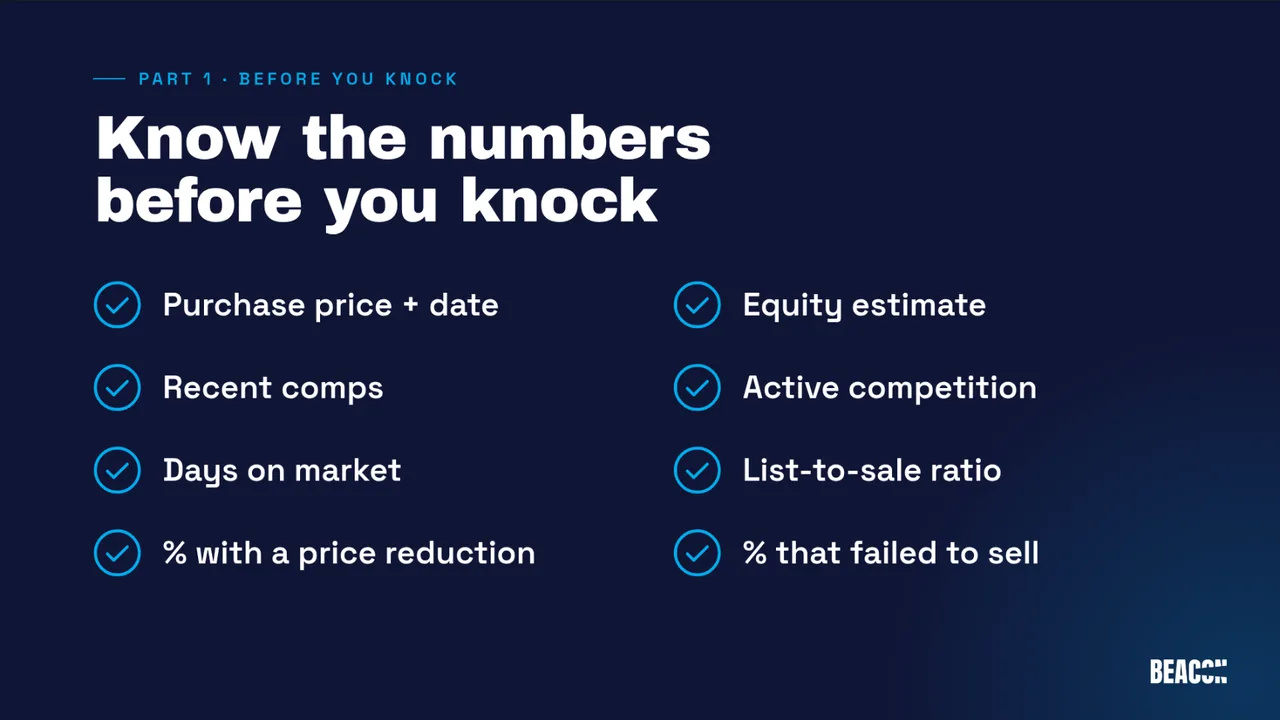
Know your numbers. Walk in knowing the purchase date and price, the seller's equity versus loan amount, sold and active comps, days on market for similar homes, and list-to-sale ratio. Also look up the percentage of listings that fail to sell in your market (withdrawals and expireds). An illustrative example: imagine that in 90 days a market had 100 sales, and 33 homes were pulled off the market. Sharing data like that, instead of pushing the seller toward a number, plants the seed early that overpricing carries real risk. He also noted that roughly one in five U.S. homes currently has a price reduction, give or take, depending on the market.
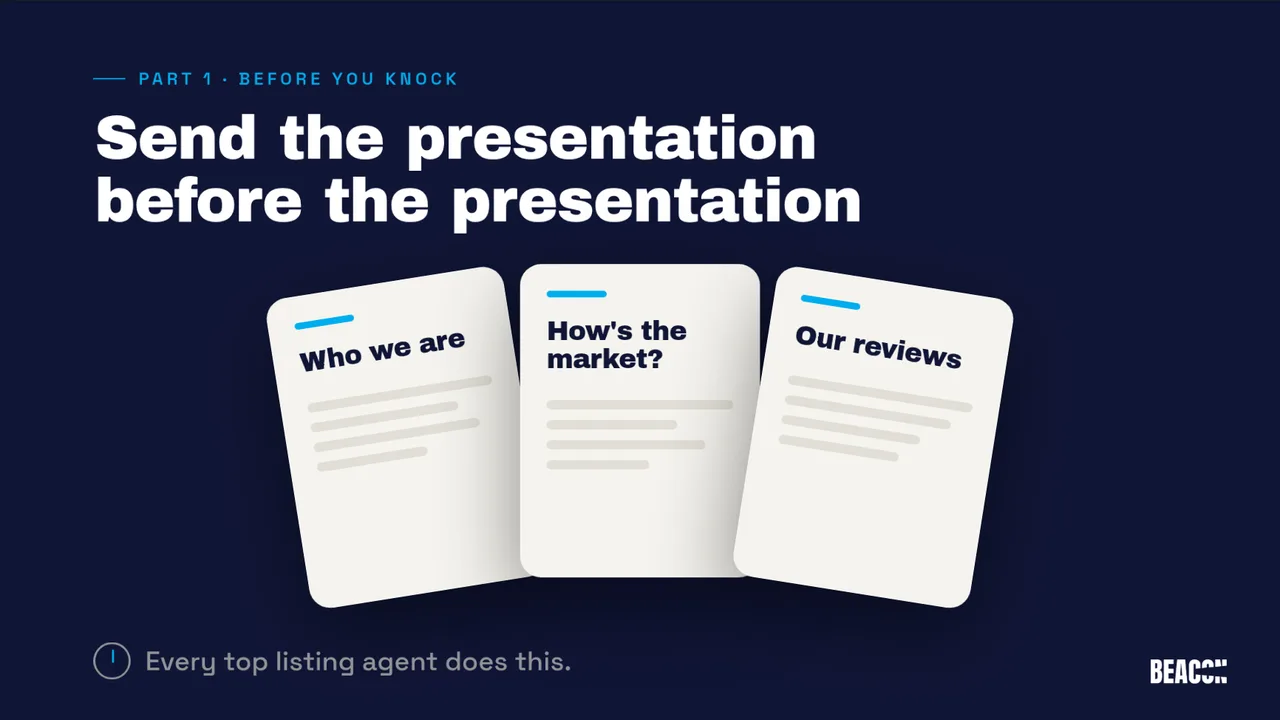
Send a pre-listing presentation. A micro-presentation, as a PDF, link, or Canva, sent about 24 hours before the appointment (a day, two at the most). Include who you are, a market snapshot for their neighborhood, and a few reviews. Jimmy's refinement: tailor "who we are" and the reviews to the home. A luxury listing should see your luxury reviews and results. A solo agent with a short track record can use brokerage stats. The payoff is that you can spend the appointment on their home and their goals instead of on yourself.
Step 2: The first 15 minutes
- Arrive 10 to 15 minutes early. Never be late. Use the time to look at the outside of the property.
- Take notes where the seller can see you. A branded notebook doubles as a small thank-you gift.
- Ask for the agenda. Chris's principle, from the book Exactly What to Say: whoever asks the questions is in control. Jimmy's version: offer a choice, such as "Would you like to strategize first, or show me around the house?" Control-minded sellers appreciate the option.
- Ask: "What will you miss most about the house?" It is an easy icebreaker, and the answer is your marketing copy. Follow with "What surprised you about living here?" and, if you are not the first agent, "Did anyone else ask you that?"

Step 3: The presentation itself
- Set the frame. Say, almost word for word: "By the end of today, we will agree on the next logical step." That can be working together or not, but everyone wants to be logical.
- Play their goals back to them. Chris calls it the five yeses: confirm when they need to be out, why they are moving, and what matters most, using the notes from your intake call.
- Explain the process before the price. Jimmy would spend about 75% of the presentation here. As Catherine Hamilton puts it: when a home is not listed, you have comps; when it hits the market, you have competition. If you only sell outcomes you do not control, you attach your value to the wrong thing. Sell the process you control.
- Make the timeline real, with dates. Show backward planning from the date they need to be out, and use buckets: prep, photo day, coming soon, and launch show marketing; open house and offers show negotiation; inspection and closing show problem solving. Jimmy's data: do not promise six months. Of 9,500 expired listings he analyzed, the average agent signed a 6-month agreement and the listing expired with 132 days left. You have six weeks, so communicate that early.
Step 4: Pricing as a strategy
Price is the hardest part of the appointment, and the one most agents handle too late. The webinar's principles:
- Plant the seed early: your market data on price reductions and failed listings makes price an adult conversation instead of an emotional one.
- Show where their home sits against the comps. An interactive chart where you move the price up or down helps a seller see how far above sold homes they are asking. Jimmy's framing: what makes your house so much more valuable than these 30 homes that all sold for less?
- Say clearly that the list price is not the sales price, and that the longer a home sits, the less it tends to sell for.
- Plan to reposition: agree up front that you will revisit price at two, four, and six weeks based on showings and offers.
Step 5: Objections, closing, and follow-up
Chris's advice: most agents wing objections. Prepare for them, and remember that a specific presentation that proactively addresses concerns prevents many of them from coming up at all. The responses taught on the webinar are below.
| What the seller says | What to say or ask |
|---|---|
| "The other agent offered a lower commission." | "I'm not sure that's the right choice for you. Based on everything we've gone over, can you see why I don't lower mine?" Or use Phil Jones's question: "If the fees were the same, would you choose me?" Then let them say out loud why you are worth more. You defend your fee by getting them to state your value. |
| "We're interviewing other agents." | Do not get defensive. Agree that it is a smart, big decision, then ask: "What would the right agent need to show you to make this an easy decision?" They will tell you what to double down on. |
| "The other agent will list it higher." | Ask first: "What makes you say that?" The answer might be a Zestimate, a neighbor, or the other agent. Then go back to the comps, the cost of days on market, and the likelihood of landing at the same price or lower after a high start. |
| "I don't want to give my house away." | Name it before they do: most people do not want to give their house away. Then walk them through your pricing process and data. |
Close with a micro-commitment. Instead of an awkward silence, ask for a small yes: "Would you mind if I step outside to check my photographer's availability for next week?" It also gives a couple a moment to talk.
Follow up the same day. Send an email that thanks them, restates their goals, and links to the presentation you gave. Add a handwritten note, and tell them that once you list, you will stay in touch every week. Chris also shared a story of an agent in a competitive high-end market who dropped off an orchid the next day with a short thank-you for letting her earn their business. The gift matters less than the follow-through.
What should be in a listing presentation?
- The seller's goals and timeline, in their words
- A unique value proposition: what you do differently, not a generic bio
- Your marketing plan by phase, on a calendar, with real dates
- Previews of what their home will look like on social media, on video, in email, and on a direct mail postcard
- Sold history and recent comparable sales, with an interactive view of active competition
- Pricing strategy and a plan to reposition if needed
- Reviews and testimonials relevant to their type of home
- A clear next step
How Beacon builds a one-of-one listing presentation
At the webinar, Chris and Jimmy launched Beacon Listing Presentations, a tool built for Realtors that creates a custom presentation from a single address. In the live demo, the build took under 60 seconds. What it includes:
- Enter an address, pick what you do best. The home does not need to be listed, and no photographer is involved. In the demo, the imagery came from Beacon technology and available data, and you can upload your own photos.
- Personalized sections: goals, unique value propositions, a marketing plan by phase on a calendar, your database strategy (including what their home would look like in an email inbox) and direct mail strategy (their home on a postcard).
- Their home, on social: mock posts of the seller's home on Instagram, Facebook, and YouTube, plus how a video would be cut into Reels, TikTok, and Facebook Reels, so the marketing plan feels real instead of abstract.
- An interactive comps chart with a price slider that shows how an asking price compares with sold homes.
- A story version of every presentation, like Instagram or Facebook stories, so it works on a phone.
- Seller engagement tracking: see when the seller opened it, which sections they viewed, and for how long, and reorder the presentation around what they care about.
- Saved templates for pre-listing presentations, plus your Beacon Seller Reports, sold history, and live data built in.
- PDF export when you need a print copy. The interactive elements work online.
- Team and brokerage visibility for leaders who want to see how presentations are being used. See Beacon for large teams and brokerages.
"That presentation you sent about marketing our home was very impressive and helpful. No one else did that." Feedback shared on the webinar by Scott Steadman, a Beacon beta tester who was the third agent to interview on an estate sale before a four-person panel, sent his pitch ahead of time with Beacon, and won the listing.
Explore the product page: Beacon Listing Presentations. If you also want to keep listings once you win them, see Beacon Seller Reports and the complete guide to seller reports.
How agents are building listing presentations today
Chris polled attendees live at the start of the webinar. The takeaways:
- Nobody rated their current presentation a 10 out of 10, and only one person gave a 9. More attendees said they wing it than rated themselves a 9 or a 10.
- The most common prep time was 30 to 60 minutes. Some prepare in under 15 minutes, and others spend two to three hours.
- Canva was the most-used tool, followed by ChatGPT and Claude. PowerPoint came next, and about 10% use a plain PDF. None of them were built for Realtors.
- The most common update cadence was annually, and a significant group had not updated in two or more years.
- About half said their presentation helps them stand out from competing agents.
Watch the webinar
The replay below is the full training, including live Q&A, and is the source for this guide. Jump to a section:
- 0:00 Intro
- 0:10 The five-step overview
- 0:12 Part 1: Before you knock
- 0:29 The first 15 minutes
- 0:37 The presentation
- 0:48 Live demo of the Listing Presentation tool
- 0:59 Pricing and the offer
- 1:06 Pricing as a strategy
- 1:13 Handling objections
- 1:26 Closing and follow-up
- 1:31 Offer recap and Q&A
How much do Beacon Listing Presentations cost?
Beacon Listing Presentations are $29 per month billed annually ($348 per year), or $49 per month billed monthly with a 7-day free trial. Seller Reports are separate, starting at $99 per month with a 7-day free trial. See the pricing on the Listing Presentations page for current details.
Frequently asked questions
What is a listing presentation?
A listing presentation is the pitch a real estate agent gives a home seller to win the listing. It explains how the agent will market and sell the home, what price they recommend and why, the timeline, their fee, and the next step. It is typically given at the seller's kitchen table and is often preceded by a shorter pre-listing presentation sent a day before.
What should be in a listing presentation?
A strong listing presentation includes the seller's goals and timeline, a unique value proposition, a marketing plan by phase with real dates, previews of how the home will look across social, video, email and direct mail, recent sold comps and active competition, a pricing strategy, relevant reviews, and a clear next step.
How long should it take to prepare a listing presentation?
Not less than 15 minutes, according to Chris Smith, who said a professional agent prepares more thoroughly for something that can earn a five-figure commission. In Beacon's live webinar poll, the most common answer was 30 to 60 minutes. Beacon Listing Presentations builds a custom presentation from an address in under 60 seconds in a live demo.
What questions should I ask on a listing intake call?
Six minimum questions: Where are you going? When do you need to be there? What is the best case scenario at the end of this process? What have you done to the house? What will you miss about the house? What is important to you about the sale? Then ask follow-up questions to dig deeper into each answer.
When should I send a pre-listing presentation?
About 24 hours before the appointment, a day or two at most. Keep it short: your bio and results, a market snapshot for their neighborhood, and a few reviews relevant to their home. That lets you spend the appointment on their home and goals rather than on your background.
What should I say when a seller says another agent offered a lower commission?
Chris Smith suggests: "I'm not sure that's the right choice for you. Based on everything we've gone over, can you see why I don't lower mine?" Phil Jones's alternative is to ask: "If the fees were the same, would you choose me?" Either way, you defend your fee by getting the seller to say out loud what your value is to them.
What should I say when a seller is interviewing other agents?
Do not get defensive. Agree that shopping around is smart for a big decision, then ask: "What would the right agent need to show you to make this an easy decision?" The seller will tell you what to emphasize.
What do I say if another agent says they will list the home higher?
Ask "What makes you say that?" first. The answer might be a Zestimate, a neighbor, or the other agent. Then return to the comps, the cost of extra days on market, and the likelihood of ending at that price or lower after a high start.
How long should a listing agreement be?
Jimmy Mackin analyzed 9,500 expired listings and found the average agent signed a 6-month agreement, and those listings expired with 132 days left on the contract. His point was that agents often have about six weeks, not six months, to get a home sold, so set that expectation early.
How often should I update my listing presentation?
Beyond adding fresh comps, the most common answer in the webinar poll was annually, and a significant group had not updated in two or more years. With Beacon Listing Presentations, each presentation is generated per property, so it is customized every time.
What questions are sellers asking AI when they choose a listing agent?
In a test Chris Smith ran with ChatGPT, the top suggested questions were: Can you show me the marketing you created for your last three listings? What price do you recommend and which comparables support it? What homes would we compete with if we listed today? What homes have you sold recently that are most like mine?
Does the property need to be listed to build a Beacon listing presentation?
No. The home does not need to be listed or ever have been listed. You enter the address, choose what you do best, and Beacon builds the presentation.
Can I download a Beacon listing presentation as a PDF?
Yes. You can download a presentation as a PDF or print it. The interactive elements, such as the price slider and animations, work best when you share the presentation online, which also lets you see what the seller viewed.
Can I see whether my seller opened the presentation?
Yes. Beacon shows when the seller opened it, which sections they viewed, and how long they spent on each, so you can reorder the presentation around what matters most to them.
How much do Beacon Listing Presentations cost?
$29 per month billed annually ($348 per year), or $49 per month billed monthly with a 7-day free trial. Seller Reports are separate, from $99 per month with a 7-day free trial.
How is Beacon different from building a presentation in Canva, PowerPoint, Gamma, or ChatGPT?
Per Chris Smith, those tools were not built for Realtors. Beacon builds a one-of-one presentation from an address, including the marketing plan on a calendar, previews of the seller's home on social and in direct mail, an interactive comps chart, a mobile story version, and tracking of what the seller viewed.