How to Price a House for Zillow Search Ranges (The Round-Number Rule Most Sellers Get Wrong)
TL;DR: Sellers price just under a round number to leave room to negotiate, but on Zillow and Realtor.com that quietly makes the home invisible. Buyers search in price bands, so an in-between number falls into the gap between the ranges buyers actually use. This explains portal search mechanics, why round-number pricing can double a home's visibility, how the same logic governs reductions, and a script to walk sellers through it at the listing appointment.
Most sellers price their home to "leave room to negotiate", listing just under a round number to feel strategic. On the search portals where buyers actually shop, that instinct quietly makes the home invisible. Buyers don't browse listings like a car lot; they type a price range into Zillow or Realtor.com and scroll what comes back. A home priced at an awkward in-between number falls into the cracks between those search ranges, and all the staging, photography, and marketing you invested in never even loads on the buyer's screen. Here's how portal search mechanics actually work, and how to walk a seller through pricing to appear rather than pricing to negotiate.
The mental model sellers bring (and why it's wrong)
Almost every seller walks into the pricing conversation with the same intuition: list just under the competition, leave a little room to negotiate down, and let buyers come to the table. It feels strategic. It's how people haggle at a flea market.
But buyers don't shop for homes the way they haggle at a flea market. They shop through a search filter. And a search filter doesn't care about your negotiating room. It cares about one thing: does your price fall inside the range the buyer typed in?
That single mechanical fact upends the "price just under" instinct, because the way portals bucket prices means the "clever" in-between number is often the one that makes a home disappear.
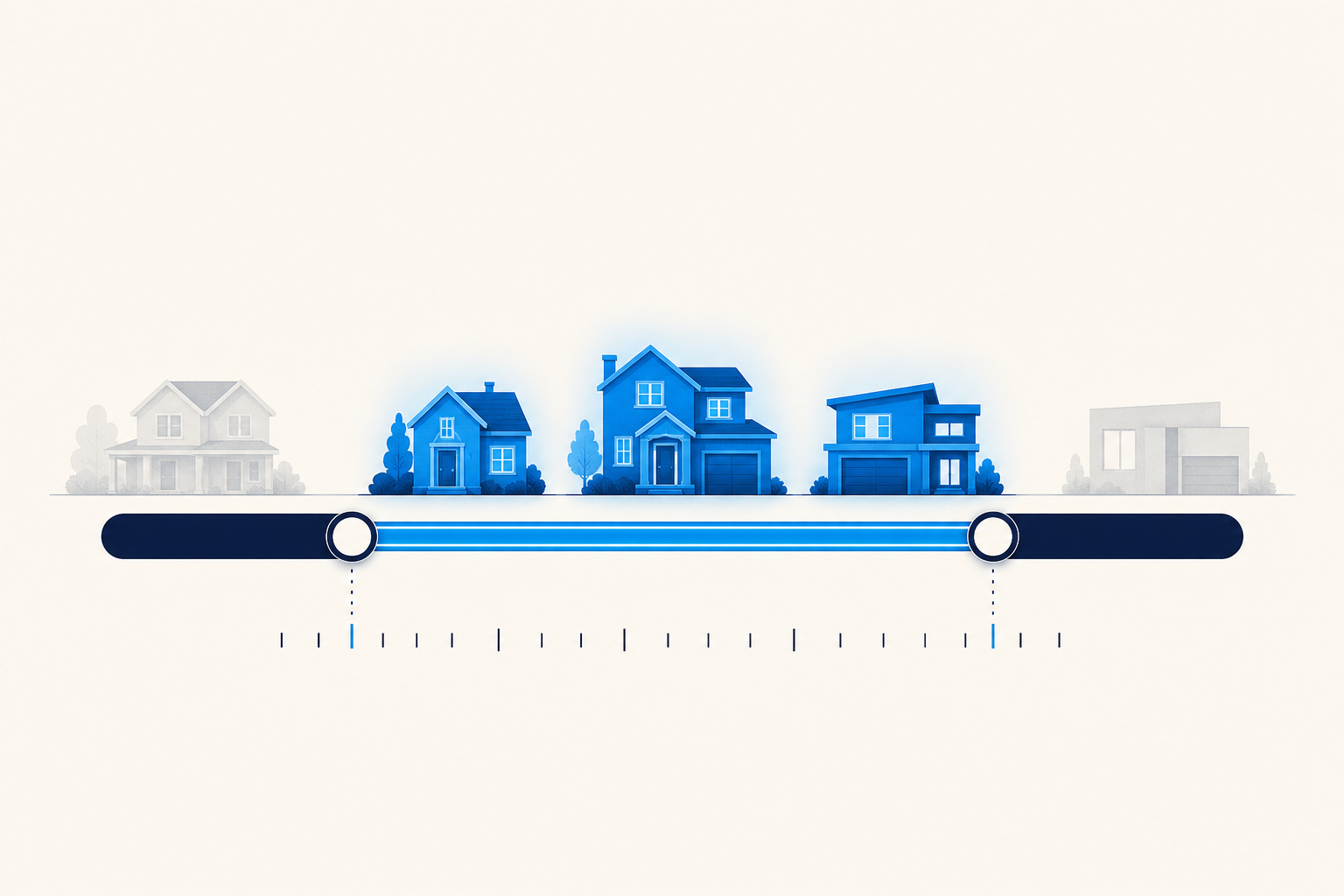
How portal search mechanics actually work
When a buyer searches on Zillow or Realtor.com, they enter a price range, usually built around round thresholds like $600K, $650K, $700K. The portal returns everything inside that band and nothing outside it. The buyer scrolls the results. Homes outside the band simply don't exist to that buyer.
Now watch what happens to specific prices:
| List Price | Visible in $575K–$650K search? | Visible in $650K–$700K search? |
|---|---|---|
| $635,000 | Yes | No |
| $650,000 | Yes | Yes |
A home at $635,000 catches the buyer searching $575K–$650K. But it completely misses the buyer searching $650K–$700K, it's $15,000 short of appearing in that band. A home at $650,000 lands inside two common search ranges at once. Double the search bands means roughly double the eyeballs and double the showings, with zero change to the home itself.
The home didn't change. The photos didn't change. The staging didn't change. The only thing that changed was whether the price landed on a threshold buyers actually search to, or fell into the gap between them.
The invisibility trap
Here's the part that should alarm every seller: when a home is priced at an odd number that falls between common search thresholds, everything else you did stops mattering.
The professional photography? Never loads. The staging that made the living room sing? Never seen. The marketing campaign, the video, the boosted posts? They can drive a motivated buyer to the listing directly, but they can't fix the fundamental problem. The home never appears in the passive, everyday portal searches that generate the majority of showing traffic. You spent money and effort making the home look irresistible to people who never get shown it.
Pricing to an in-between number doesn't leave room to negotiate. It leaves the home off the screen.
The same logic applies to reductions
This isn't just a launch-day issue. It governs price reductions too, and most agents get this wrong.
A reduction from $635,000 to $619,000 feels like a meaningful move to the seller: $16,000 is real money. But to the market, it signals almost nothing, and critically, it opens no new search ranges. Both prices sit in the same awkward gap. You've spent the seller's equity and gotten no new visibility for it.
A clean move from $635,000 to $600,000, by contrast, does two things at once. It's a visible reset the market actually registers, buyers who saw the home before notice it dropped. And it repositions the home onto a major threshold, dropping it into an entirely new pool of buyers whose searches top out at $600K. Same reduction dollars working far harder, because the new number is one buyers actually search to.
| Reduction | New Search Ranges Opened | Market Signal |
|---|---|---|
| $635K → $619K | None | Low |
| $635K → $600K | New pool at $600K cap | Strong reset |
How to walk a seller through it
The move is to introduce this at the listing appointment, before the sign goes in the ground, not after the home has sat for a month at an awkward number.
Here's a way to frame it:
"Buyers don't scroll every listing. They search a price range and look at what comes back. Right now, the price you're thinking of lands between the ranges most buyers in your tier are actually searching. If we move it to [round threshold], your home shows up in searches that buyers at this level are running today, which means more of the right people actually see all the marketing we're about to do for you."
Then show them, concretely, where their number lands relative to the search thresholds that matter in your market. Most sellers have never once thought about their price from the listing side, they've only ever thought about it as buyers, or as negotiators. Seeing the search-band map is usually a genuine "I had no idea" moment.
When the logic is that concrete, "at $600K, your home appears in searches buyers in your tier are running right now", it becomes a rationale the seller can hold onto and repeat to their spouse. And it makes every pricing conversation after that, including any future reduction, dramatically easier, because you've already established that price is about visibility, not just value.
Frequently asked questions
How should I price my house for Zillow and Realtor.com searches? Price to a round threshold that buyers actually search to (like $600K or $650K) rather than an awkward in-between number. Buyers filter by price range, so a price sitting on a common threshold appears in more search bands and reaches more buyers, while an in-between price can fall into the gap and stay invisible.
Why does pricing just under a round number hurt visibility? Because buyers search in ranges built around round numbers. A home at $635,000 misses the $650K–$700K search band entirely, while a home at $650K can appear in two bands at once, roughly doubling the buyers who see it with no change to the home.
How much should I reduce my price to actually get noticed? Enough to cross into a new search threshold. A drop from $635K to $619K opens no new search ranges and signals little; a move to $600K creates a visible reset and exposes the home to a new pool of buyers whose searches cap at $600K.
When should I explain price-range mechanics to a seller? At the listing appointment, before listing. Show them where their intended price lands relative to the search thresholds in your market. Framing price as a visibility decision upfront makes every later pricing conversation, including reductions, much easier.
Source: How to Price for the Search Range, Not Seller Preference by Darryl Davis, Inman (July 9, 2026).