Attention Isn't Demand: Why Viral Listings Don't Always Sell (and What to Do Instead)
TL;DR: New Orleans' Fisherman's Castle generated three years of viral attention and national press, and still didn't sell, proving the most misunderstood idea in listing marketing: attention and demand are not the same thing. This explains why viral listings so often fail to convert, and the one question, who is the specific buyer this story is written for?, that turns reach into an actual offer.
A listing can generate thousands of headlines, dedicated Reddit threads, and national press, and still sit unsold for three years. New Orleans' "Fisherman's Castle" just proved it, taking a $100,000 price cut after going to market in July 2023. It's the clearest reminder in recent memory of the single most misunderstood idea in listing marketing: attention and demand are not the same thing. This post breaks down why viral listings so often fail to sell, and the one question that separates content that gets seen from content that gets an offer.
The castle that everyone saw and nobody bought
On paper, New Orleans' Fisherman's Castle is the viral listing playbook made flesh. Medieval stone walls. Turret towers. A literal drawbridge entrance. Waterfront access. It's the kind of home that makes people stop mid-scroll, screenshot it, and text it to a friend.
And for three straight years, that's exactly what it did. Reddit threads. Social posts. National coverage. The listing had a remarkable hook, a built-in story, and a detail no one could forget.
What it didn't have was a buyer. After sitting on the market since July 2023, it recently took a $100,000 price cut, still searching for someone willing and able to close.
The instinct is to say the marketing failed. It didn't. The marketing succeeded wildly at the thing marketing does: earning attention. What failed was the assumption that attention would convert into demand.
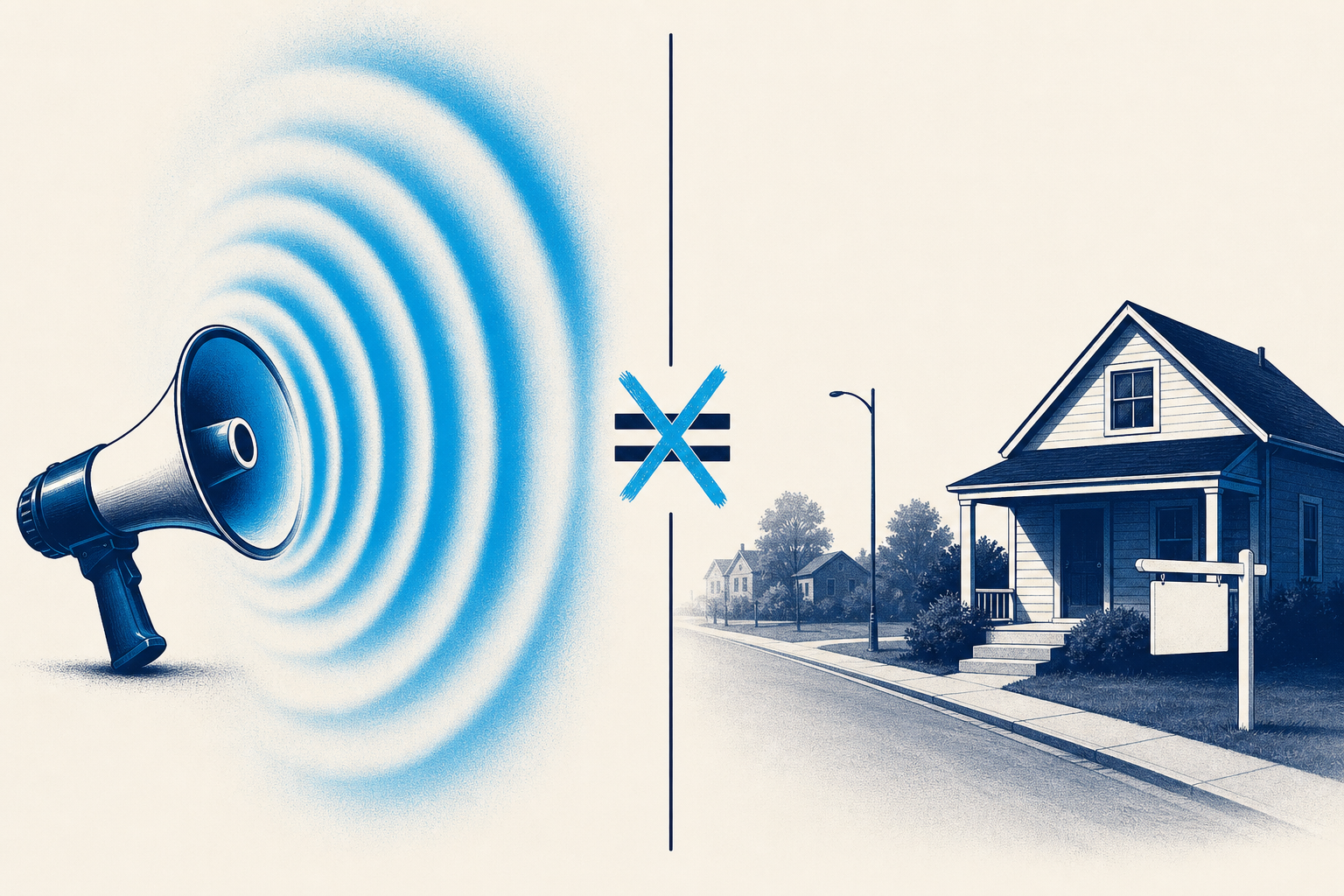
Novelty generates reach. Reach doesn't sign contracts.
Here's the chain most agents implicitly believe:
Remarkable feature → reach → views → saves → offer
The first four links are real. A remarkable home does generate reach, reach does generate views, and views do generate saves. But there's a break in the chain that the castle exposes: saves don't sign contracts.
A save is a bookmark of a feeling. Someone saw a castle, felt something, delight, fantasy, "imagine living there", and tapped save. That emotion is genuine. It's just not the same thing as being a pre-qualified buyer in that market, at that price point, who wants a medieval waterfront fortress badly enough to close on it.
Novelty is extremely good at generating the top of that chain and extremely unreliable at generating the bottom. The wider and weirder the reach, the less likely any given viewer is an actual buyer, because you've optimized for "impossible to ignore" rather than "right for the person who can purchase."
The real problem: audience mismatch
What went wrong with the castle wasn't the marketing quality. It was the mismatch between the audience the listing attracted and the audience that could actually buy it.
Viral content, by its nature, speaks to everyone. It's engineered for the widest possible reaction. But a specific home, especially a highly specific, unusual one, needs a specific buyer. When your content speaks to everyone, it converts for no one, because "everyone" is not a buyer profile. The castle found its audience. It just never found its buyer, because those turned out to be two completely different groups of people.
This is the trap: the more universally appealing your listing content is, the further it can drift from the narrow slice of people who could realistically transact.
The one question to add to your listing narrative
None of this means stop building listings around remarkable features. You absolutely should, a distinctive hook is what earns the right to be seen at all. The fix is to add one question to the process:
Who is the specific buyer this story is written for?
Ask it before you build the campaign, not after it goes viral. Then engineer the content to reach that person, not to maximize raw reach.
Concretely, that means:
- Define the buyer profile first. Not "anyone who loves unique homes." Who has the income, the motivation, and the taste to buy this home? Where do they live now? What do they search for?
- Aim the distribution at them. A viral organic post reaches everyone; a targeted ad reaches a defined audience. For a specialized property, a smaller, sharper spend aimed at the real buyer profile often outperforms a million random views.
- Write the hook for the buyer, not the crowd. "You'll never believe this castle exists" is crowd copy. "For the buyer who's always wanted a waterfront home with genuine architectural character" is buyer copy. Same house, different target.
- Measure the right signal. Track showing requests and qualified inquiries, not just views and saves. If reach is climbing but qualified showings aren't, that's the castle problem forming in real time.
Attention earns the right to be seen. Strategy earns the offer.
The lesson isn't "viral listings are bad." It's that virality is the beginning of the job, not the end of it. Attention gets the listing seen. Strategy, knowing exactly who the buyer is and aiming everything at them, gets the offer.
The agents who understand this design their listing marketing in two layers: a hook remarkable enough to stop the scroll, and a targeting strategy precise enough to reach the person who can actually close. One without the other is either invisible or, like the castle, endlessly admired and never sold.
And when a listing does take longer, as distinctive homes often do, the same clarity protects your relationship with the seller. Being able to show the seller what kind of attention the listing earned, what it meant, and why the strategy is what it is turns a scary silence into an informed conversation. That's the whole reason to document and interpret the numbers rather than just report them.
Frequently asked questions
Why do viral listings often fail to sell? Because attention and demand are different things. Viral content generates broad reach among people reacting to a novelty, but very few of those viewers are qualified buyers for that specific home at that price. Novelty drives views and saves; it doesn't guarantee an offer.
Do saves and views on a listing mean it will sell? No. Views and saves measure interest and reach, not purchase intent. A save is essentially a bookmark of a feeling. The metrics that actually predict a sale are qualified showing requests and offers.
Should agents still market unusual homes with a viral hook? Yes, a remarkable hook earns the attention needed to be seen at all. The key is to pair it with a defined buyer profile and targeted distribution so the content reaches the specific person who can actually buy, not just the widest possible crowd.
How do you market a hard-to-sell unique property? Lead with the distinctive feature to earn attention, but define the exact buyer profile first, aim paid distribution at that profile rather than chasing raw reach, write the hook for that buyer, and track qualified showings rather than views.
Source: Will New Orleans' Quirky 'Castle' Ever Find a King? by Kelsi Karruli, Realtor.com (July 7, 2026).